Dalluge Titanium Hammers
Framing hammers for people who drive nails by hand all day
Dalluge makes framing hammers for carpenters, framers and roofers. The titanium models put a full-size framing head on just 14 or 16 oz, so you keep the reach and face of a big hammer with less weight to swing overhead. The framing models come with a magnetic nail starter, a rip claw and an American hickory handle, and the 21 oz cast-head models are there if you'd rather have the heft.
- 4.6/5 from 400+ reviews
- Titanium heads in 14 and 16 oz
- Replaceable American hickory handles
Shop Dalluge Hammers
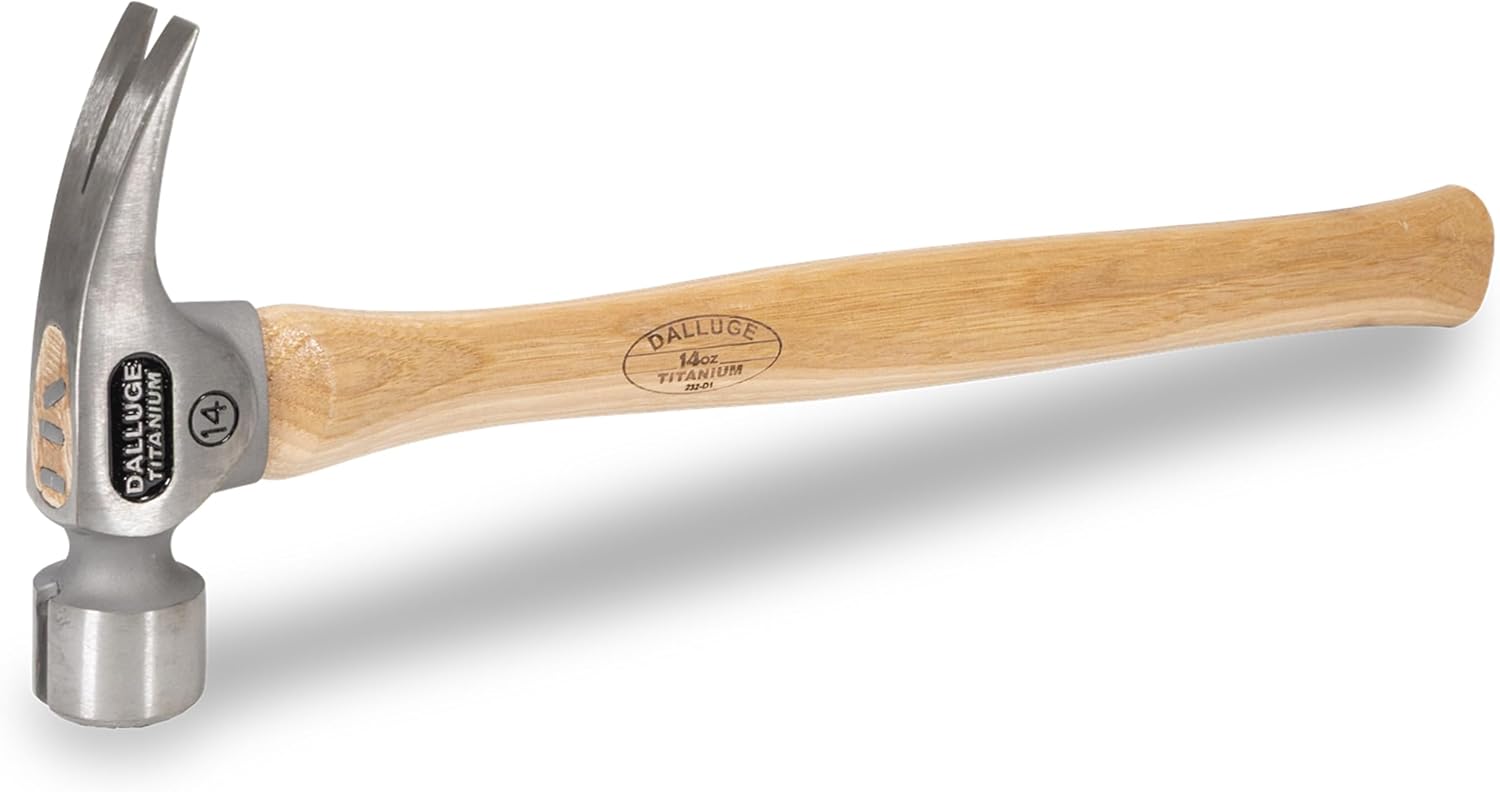
Models 7170, 7172, 7175
Dalluge 14 oz Titanium Framing Hammer
- Head
- 14 oz titanium, milled face
- Handle
- Straight hickory, fiberglass or 19" curved hickory
- Built in
- NaiLoc magnetic nail starter, rip claw
The lightest head in the Dalluge framing range, on a full-size framing profile. Look here if a lot of your nailing happens overhead or off a ladder, or you just want less weight on your elbow by the end of the day. The 7172 swaps hickory for fiberglass, and the 7175 has a longer, curved grip.
Check price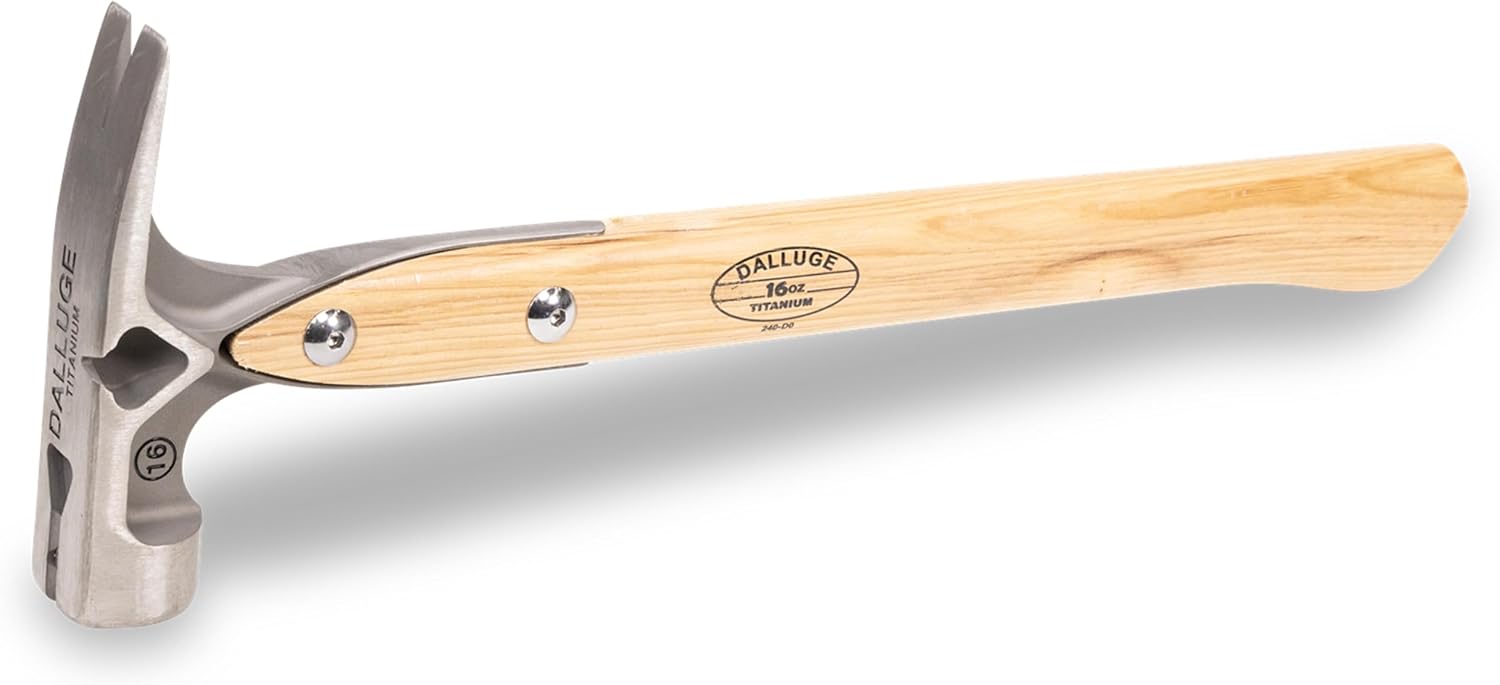
Models 7180 (milled), 7182 (smooth)
Dalluge 16 oz Titanium Framing Hammer
- Head
- 16 oz one-piece titanium
- Handle
- 17" American hickory, overstrike guard
- Built in
- SideWinder puller, NaiLoc starter, rip claw
The all-rounder. A little more head than the 14 oz, plus the SideWinder side puller and a titanium shank that takes the hit when you miss. Get the 7180 milled face for framing and decks, or the 7182 smooth face (shown) for wood that stays visible. Older ones are stamped DDT16 and DDT16P.
Check price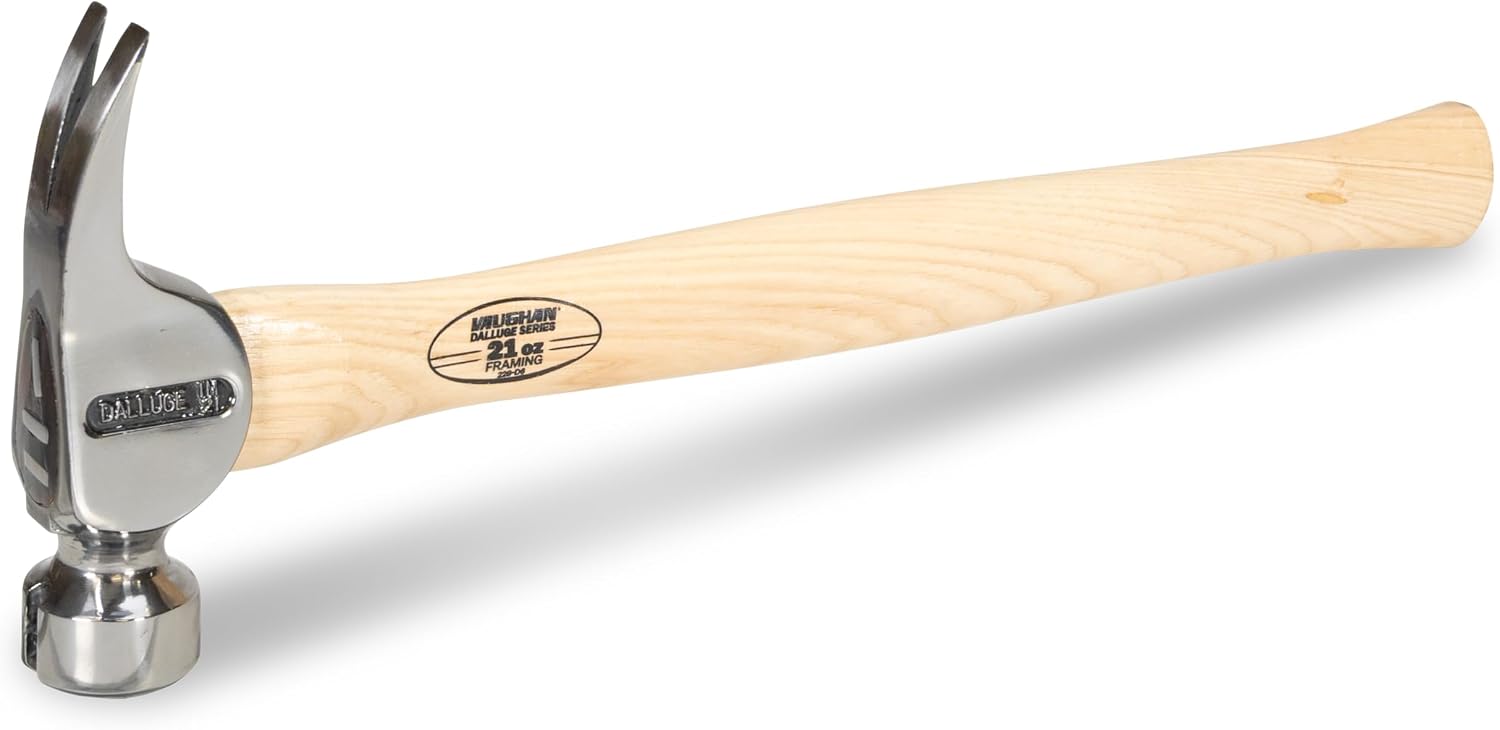
Models 2110 (straight), 2115C (curved)
Dalluge 21 oz Framing Hammer
- Head
- 21 oz cast head, milled face
- Handle
- Long hickory, straight or curved
- Built in
- Magnetic nail holder, rip claw
For framers who like a traditional, heavier hammer. The extra head mass carries momentum into big framing nails, and it costs less than half what the titanium models do. The 2110 has a straight handle and the 2115C a curved one. Otherwise they are the same hammer.
Check price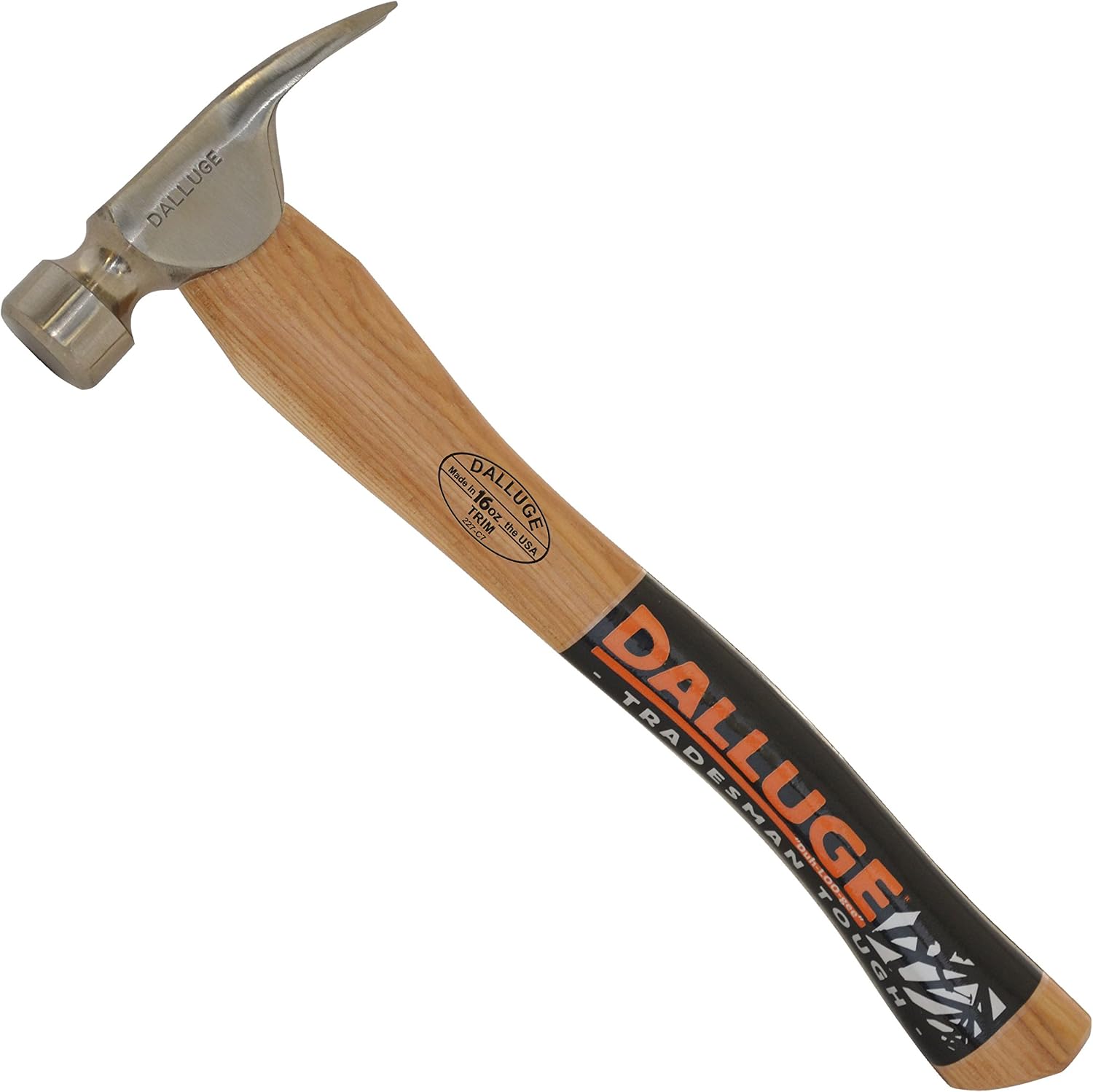
Model 1650 (VN01650)
Dalluge 16 oz Trim Hammer
- Head
- 16 oz steel, smooth face
- Handle
- American hickory
- Built in
- Straight claw, stamped Made in the USA
A smaller hammer for trim, siding, cabinets and punch-list work, where a framing hammer is more than you need. The smooth face is easier on finished surfaces, and it hangs lighter on a tool belt next to your framer.
Check priceOther configurations, handles and pullers
7172
14 oz titanium, fiberglass handle
7175
14 oz titanium, 19" curved hickory
7180
16 oz titanium, milled face
2115C
21 oz cast head, curved hickory
Handles
VN03700, VN03750, VN03800
DA Bar
Nail pullers and pry bars
Can't find the exact model? Search by its number. Dalluge hammers are often listed under Vaughan part numbers, so the 7182 may show up as VN07182.
Which Dalluge Hammer Fits Your Work
Overhead work and long days
If you swing a hammer a few thousand times a day, a lighter head is easier to keep accurate, especially at shoulder height and above.
- 14 oz titanium is the lightest framing head in the range
- Fiberglass 7172 holds up to rain and humidity
- Curved 19" 7175 adds reach when you have room to swing
- The magnetic starter sets a nail with one hand
One hammer for framing and remodeling
For a single premium hammer that frames, pulls nails and handles light demo, start with the 16 oz titanium.
- 7180 milled face for framing, decks and subfloor
- 7182 smooth face when the wood will show
- SideWinder puller for nails the rear claw can’t get at
- Overstrike guard protects the handle under the head
Heavy framing on a budget
Some framers just like a heavier hammer. The 21 oz cast-head models give you that momentum at a much lower price.
- 2110 straight or 2115C curved hickory handle
- Milled face and rip claw for rough work
- Magnetic nail holder, same as the titanium models
- For trim and finish work, add the 16 oz 1650
On a production framing crew the nail gun still does most of the work. A good hand hammer earns its keep on corrections, blocking, toenailing and every spot the nailer won't reach, or when the compressor isn't set up yet.
What's Built Into a Dalluge Hammer
Titanium head
Titanium is much less dense than steel, so a full-size framing head weighs 14 or 16 oz. A lighter head gets up to speed faster and is easier to control. It doesn’t hit harder on its own, though. What drives the nail is head weight, swing speed and how squarely you connect. And titanium doesn’t rust.
NaiLoc magnetic nail starter
A magnet and slot on top of the head hold a steel nail, so you can set it with one swing and keep your other hand on the blocking or the ladder. Once it bites, drive it like normal. It won’t hold stainless, aluminum or other nonmagnetic fasteners.
SideWinder nail puller
On the 16 oz titanium models, a notch on the side of the head catches a nail at an angle the rear claw can’t reach, and you lever it out against the handle. It’s made for pulling framing mistakes. Heavy structural prying is still a job for a bar.
Milled or smooth face
A milled face has a waffle texture that grips the nail head and cuts down on glancing blows. It also marks the wood, which doesn’t matter on framing that gets covered. A smooth face leaves no pattern, but a miss will still dent the board.
Rip claw
The claw is straighter than on a household hammer, so you can drive it between boards to split them apart, lift sheathing or pull nails. For bigger tear-outs, use a wrecking bar so you aren’t loading the handle.
Overstrike guard
On the 16 oz titanium hammers, the head runs down the handle as a titanium shank. When you miss the nail and hit the lumber, the metal takes the blow instead of the wood. It helps a lot, but it won’t make a handle indestructible.
Compare Dalluge Hammer Models
| Model | Head | Face | Handle | Stands out for |
|---|---|---|---|---|
| 7170 | 14 oz titanium | Milled | Straight hickory | Magnetic nail starter |
| 7172 | 14 oz titanium | Milled | Straight fiberglass | Weather-resistant handle |
| 7175 | 14 oz titanium | Milled | 19" curved hickory | Longer reach |
| 7180 | 16 oz titanium | Milled | 17" hickory, overstrike guard | SideWinder nail puller |
| 7182 | 16 oz titanium | Smooth | 17" hickory, overstrike guard | Smooth face and SideWinder |
| 2110 | 21 oz cast | Milled | Straight hickory | Traditional framing weight |
| 2115C | 21 oz cast | Milled | Curved hickory | Curved framing handle |
| 1650 | 16 oz steel | Smooth | Hickory | Trim hammer, made in the USA |
- Head weight means the head alone. The hammer you carry weighs more once the handle and fittings are added.
- Dalluge hammers are often listed under Vaughan part numbers. The 7180 is VN07180 and the 7182 is VN07182. Older 16 oz hammers stamped DDT16 (milled) and DDT16P (smooth) are the same two models.
- Handle lengths in older catalogs don’t always match current production. If you’re replacing a hammer or matching one on your crew, go by the full model number, not the photo.
14 oz vs. 16 oz vs. 21 oz
14 oz Titanium
Lightest head, least fatigue
- Models
- 7170, 7172, 7175
- Extras
- NaiLoc nail starter
- Best for
- Overhead, roofing, all-day nailing
- Typical price
- $170 to $185
The lightest framing head Dalluge makes. Less mass to swing means less strain on your arm over a long day, and an easier time staying accurate above your head. It’s still a full-size framing hammer, not a trim hammer.
16 oz Titanium
The one most framers pick
- Models
- 7180, 7182
- Extras
- SideWinder, overstrike guard
- Best for
- Framing, decks, remodeling
- Typical price
- $185 to $230
A modest step up in head weight from the 14 oz, plus the SideWinder puller and the titanium shank that protects the handle. If you want one hammer that does most jobs, this is usually it.
21 oz Cast Head
Most momentum, lowest price
- Models
- 2110, 2115C
- Extras
- Magnetic nail holder
- Best for
- Heavy framing, demolition
- Typical price
- $75 to $85
The weight of a classic heavy framing hammer. It suits a strong, controlled swing and people who like to feel the head do the work. Expect more fatigue than with titanium, at well under half the cost.
- Going from 14 oz to 21 oz adds 50% more head weight, but it doesn’t drive nails 50% harder. Swing speed and a clean hit matter as much as mass, so the right weight is the one you can hit accurately all day.
- Titanium or steel: titanium costs more and gives you a lighter head of the same size that won’t rust. Steel is cheaper and gives you more mass if you like a heavy hammer. If you only drive nails now and then, a steel hammer is plenty.
- Hickory or fiberglass: hickory takes some of the sting out of each hit and can be replaced when it wears out. Fiberglass doesn’t swell or shrink with moisture, which helps if you work outside in any weather.
- Straight or curved handle: neither is more accurate. A straight handle lets you choke up and move your grip along it, and a curved one sits differently in the palm. Longer handles add leverage and speed but need more room to swing.
- Typical prices are US retail as of October 2026. Actual prices change with the seller, the model and current deals.
Dalluge Hammer Reviews
Im a framer and Carpenter. This hammer is very good for the price. I have purchased 3 pf them.
Outlaw Wood and Construction
Well balanced and easy to swing. I had a 22 oz smooth faced hammer but have been finding myself away from the pneumatic guns lately or arriving on site before the compressor is set up and needing to hand drive 16d sinkers. I grew up in the age before pneumatic nailers and forgot how much enjoyment I got from hand driving nails. I wish I would have had this beauty back then. Recently we were adding a door header that was missed on layout. The nailer ran out of nails and the guy operating it was out as well. So off he went to get more nails out of the trailer. I had a pouch of sinkers and by the time he got back I had the header done and the king and jack on one side. And absolutely no fatigue.
Curmudgeon
Perfect framing hammer, for me and my application, it hits hard and is an extension of my hand, not overly heavy and not too light, the hatchet style handle offers an excellent angle of approach for driving 20P. To 60P. Galvanized nails without much effort. . . And keeps my knuckles off the lumber. As far as the handles go, the grain orientation to the head is quite ideal, sometimes in Perfect alignment. The varnish on the handle is there to do 2 things, keep it pretty until it's purchased and allow you to see the grain of the handle. As a general rule, never purchase a wooden handled striking tool with a painted handle, paint hides flaws. I always sand the factory varnish off, and properly apply boiled linseed oil. Preserves the wood and helps with the grip in wet weather. And just as a side note, your hammer should fit you, not Billyray gorilla hands, work smarter not harder. . .and if you find your breaking handles. . . They make nail pullers for a reason. . .
Wicked
This hammer exceeded my expectations. The 22 oz weight gives it great driving power without feeling overly heavy, and the balance is spot on. The grip is comfortable and reduces vibration, which makes a big difference during longer jobs. The rip claw pulls nails clean with minimal effort, and overall it just feels like a high-quality, durable tool. Whether you’re doing framing work or general use, this hammer gets it done. Definitely a solid addition to any toolbox.
Garner2204
Nice hammer. It's really well made. I'm a licensed plumber and accidentally left my hammer on a job somewhere. I needed to order a new one. I was going to order another Estwing. I had a quality hammer. When I started looking on Amazon (because I was lazy and just wanted to order something for next day without going to the Depot) I found this hammer. It looked good and also had the option for the cap. I've actually never seen hammers with that option but that will definitely come in handy. I can definitely use the softer cap for certain things. When it arrived I could see how well made it is. I'm very happy with it and it was cheaper than the hammer I was originally going to get. Also it doesn't look like anyone else's hammer. I had the Estwing with the blue handle. I see those all the time on jobs. It's possible someone grabbed mine by accident. Its less likely to happen with this hammer. I put my initials on all my tools but mistakes happen. As long as no one takes my Milwaukee Forge batteries by accident, I can handle it. These batteries are costing more than the tools these days. That's a whole other issue but this hammer is great.
Erin
Very light, nice quality, nail set works well. I got it because I wanted a hammer with a wooden handle (easier to get in and out of hammer loop on tool belt) that I could still use to pull nails. It’s great. Allen screws need to be tightened so head is attached properly.
Adam R. Miller
Replacement Handles and Hammer Care
| Hammer | Description | Replacement handle |
|---|---|---|
| 7170 | 14 oz titanium, straight hickory | VN03700 |
| 7175 | 14 oz titanium, curved hickory | VN03750 (19" curved) |
| 7180, 7182 | 16 oz titanium | VN03800 |
| 2115C | 21 oz, curved hickory | VN03750 (19" curved) |
| 2110 | 21 oz, straight hickory | Often listed as VN03700, confirm the eye size |
- 1
Look the hammer over before work
Check for a loose head, a cracked or splintered handle, a chipped face or a bent claw. Any one of those makes the hammer unsafe to swing, so deal with it before you go back to nailing.
- 2
Keep the handle screws tight on 16 oz titanium models
The hickory handle on the 7180 and 7182 is bolted to the titanium shank with two screws. Snug them when the hammer is new and check them every so often. A head that feels loose usually just needs those tightened.
- 3
Keep the striking face clean
Oil, sealant or pitch on the face makes it skate off nail heads. Wipe it off before it causes a glancing blow.
- 4
Store it dry
Hickory doesn’t like sitting in standing water or baking in a hot truck for weeks. A dry spot keeps the wood sound and the head tight.
- 5
Replace a cracked handle right away
Order by your exact model number. Handles that look alike don’t always fit the same eye, and a badly fitted handle lets the head work loose. Follow the fitting steps for your model when you install it.
- 6
Don’t modify the head or hit hardened steel
Grinding, welding or reshaping a titanium head can weaken it. And don’t use a framing hammer on steel punches, cold chisels or other hardened tools unless the maker says it’s OK.
Vintage and Older Dalluge Hammers
Older Dalluge hammers turn up at flea markets, estate sales and on resale sites. Many carry legacy numbers instead of current Vaughan part numbers. A DDT16 is what’s now sold as the 7180 (milled face), and a DDT16P is the 7182 (smooth face).
Before you put a used one back to work, check the head for cracks or deformation and make sure it’s tight on the handle. A clean head can still be sitting on an old, dried-out handle.
Stamps and labels tell you the model, not necessarily the year it was made. Collectors usually want the original handle and finish. If you plan to swing it, a new handle is the safer choice.
About Dalluge Hammers
Dalluge made its name with framing and decking tools, mainly titanium hammers and nail pullers. The designs are practical: a head-to-handle weight ratio that keeps the hammer easy to swing all day, faces and claws shaped for framing, and small things like the magnetic nail starter that save you a step on every nail.
The brand became part of Vaughan & Bushnell, an American toolmaker that started in 1869 with an improved post auger and went on to make framing hammers, nail pullers, axes and pry bars. Vaughan hammer heads have been made in Bushnell, Illinois, and its hickory handles in Walnut Ridge, Arkansas.
In May 2024, MARSHALLTOWN acquired Vaughan & Bushnell’s assets, and Dalluge came with them. The lineup is still in production: titanium framing hammers, 21 oz cast-head framing hammers, replacement handles and DA Bar nail pullers.
That history is why you’ll see the hammers sold under both names. Vaughan is the broader tool brand and Dalluge is its specialty framing line, so a listing for a "Vaughan 16 oz Titanium" may well be the Dalluge 7182 (VN07182). Where a hammer is made can vary by model, so check the label on the one you’re buying if Made in the USA matters to you.
Frequently Asked Questions About Dalluge Hammers
A Dalluge hammer is a professional framing hammer made for carpentry, structural framing, roofing and demolition. The brand is best known for its precision-cast titanium hammers, which pair a light head with a long handle and built-in nail-pulling features. The lineup includes 14 oz and 16 oz titanium models and heavier 21 oz cast-head framing hammers, all aimed at tradespeople who drive a lot of nails by hand.
Dalluge hammers are part of the Vaughan tool lineup, which is now owned by MARSHALLTOWN. Vaughan & Bushnell was founded in 1869 and built a wide range of professional striking tools. In May 2024, MARSHALLTOWN acquired Vaughan & Bushnell’s assets, including the Dalluge brand, and Dalluge hammers are still sold as part of the Vaughan family of framing tools.
Dalluge has deep roots in American toolmaking through Vaughan and MARSHALLTOWN. Vaughan has made hammers in Bushnell, Illinois, and hickory handles in Walnut Ridge, Arkansas. That said, where a hammer is made or assembled can vary by model and production run. Check the label on the specific hammer rather than assuming every Dalluge is made in the USA.
Titanium is less dense than steel, so a Dalluge titanium hammer gets a full-size framing head at 14 or 16 oz. The lighter head is easier to get up to speed and control over thousands of swings, especially overhead. Titanium also resists corrosion. Steel hammers usually cost less and give you more head mass if you like that feel. Titanium isn’t automatically more powerful, because impact depends on both head weight and swing speed.
The Dalluge 7180 is a strong all-around framing hammer. It has a 16 oz titanium head with a milled face, a 17" hickory handle, the SideWinder nail puller and the NaiLoc magnetic nail starter. If you want a lighter head, look at the 14 oz titanium models. If you prefer the momentum of a heavier, conventional hammer, the 21 oz cast-head 2110 and 2115C are the better fit.
The striking face. The 7180 has a milled face that grips nail heads better, especially on slightly off-center hits. The 7182 has a smooth face that won’t leave a waffle pattern on the wood. Everything else is the same: a 16 oz precision-cast titanium head, 17" hickory handle, overstrike guard, SideWinder nail puller and NaiLoc magnetic nail starter. Their Vaughan part numbers are VN07180 and VN07182.
The 14 oz is lighter and may suit you better for a lot of overhead work or if swing control is your priority. The 16 oz models have a bit more head weight and add the SideWinder nail puller and overstrike guard. Both handle professional framing. The right pick depends on your swing, the handle you like and the nails you drive. A heavier head isn’t better if it slows your swing or costs you accuracy.
The SideWinder is a nail-pulling notch built into the side of the Dalluge 16 oz titanium heads. It gives you a second way to catch a nail and lever it out against the handle, which can be easier than the rear claw when the nail head sits at an awkward angle. It’s meant for routine nail pulling, like fixing framing mistakes or remodel work, not heavy structural prying. Use a pry bar for that.
The NaiLoc magnetic nail holder keeps a steel nail against the head so you can start it with one hand. Set the nail in the holder, line up the point where you want it, and give it a controlled swing to seat it in the wood. Then drive it normally. It’s most useful for overhead framing, roof work and anywhere your other hand has to hold the piece. Nonmagnetic fasteners won’t stay in it.
Choose a milled face for rough framing, decking and other work where the look of the wood doesn’t matter. The texture helps keep the face on the nail head. A smooth face is the more versatile choice around exposed lumber or anywhere a waffle pattern would look bad. The smooth-face 7182 suits carpenters who do both framing and general carpentry. Neither face prevents damage from a missed swing.
Dalluge titanium hammers sit at the premium end of framing hammer prices. As of October 2026, MARSHALLTOWN lists the 14 oz models at about $170 to $175 and the 16 oz models at about $188. Retail prices vary by seller, model, stock and current deals. The price over a steel framing hammer comes from the titanium itself, the casting process and the built-in features.
Yes. Replacement hickory handles are available for most Dalluge models. VN03800 fits the 16 oz titanium 7180 and 7182. VN03700 fits the straight-handle 14 oz 7170, and VN03750, a 19" curved handle, fits the 7175 and the 21 oz 2115C. The 21 oz 2110 takes a straight replacement handle too. Always match the handle to your exact model and follow the right installation steps. Replace a cracked, loose or badly damaged handle before you use the hammer again.
Yes. Older Dalluge hammers show up with used tool dealers, on resale sites and at specialty tool sellers. Vintage ones may carry legacy numbers like DDT16 or DDT16P, and some older models have different handle lengths or specs than current ones. Before you buy a used one, check the head for cracks or deformation and make sure the handle is solid. Markings can identify the model, but they don’t always tell you when it was made.
MARSHALLTOWN acquired Vaughan & Bushnell’s assets in May 2024. The deal included both the Vaughan and Dalluge brands, so the existing hand-tool designs carry on under new ownership. Dalluge titanium and cast-head framing hammers are in the MARSHALLTOWN catalog, along with replacement handles. The brand is still aimed at professional carpentry and construction rather than general household use.
For a carpenter who drives nails by hand every day, a Dalluge titanium hammer can easily earn its price. The lighter framing head is easier on your arm, and the 16 oz models save tool changes with the built-in nail starter and puller. For occasional repairs around the house, a regular steel hammer is the more economical choice. Dalluge makes the most sense if you know what head weight, balance and nail-pulling features you want. Fit matters more than price.
Pick the Weight, Then the Face
Go 14 oz for overhead and all-day nailing, 16 oz for one hammer that does it all, or 21 oz if you like the heft. Then choose a milled face for framing or a smooth face for wood that stays visible.
Shop Dalluge Hammers